What Does Kathe Kollwitz Art the Mothers Show Never Again War by Kathe Kollwitz

Käthe Kollwitz: Memorialization every bit Anti-Militarist Weapon
Independent Scholar, T12 VH72 Cork, Ireland
Received: 13 November 2019 / Revised: half dozen January 2020 / Accepted: 30 January 2020 / Published: 10 March 2020
Abstract
This essay explores Käthe Kollwitz's antiwar graphic work in the context of the German, and later, international No More War movement from 1920 to 1925, where information technology played an important role in antimilitarist campaigns, exhibitions, and publications, both in Frg and internationally. Looking at Kollwitz's product closely, we observe a deeply businesslike artistic strategy, where the emotionality of Kollwitz'due south famed prints was the result of tireless technical, formal, and compositional investigation, contrived to maximize emotional touch. Past choosing the hands disseminated medium of printmaking every bit her main vehicle and using a deliberately spare just powerful graphic language in carefully chosen motifs, Kollwitz intended her fine art to reach equally wide an audience as possible in engaging antiwar sentiment. In connection with the leading antiwar voices of the time, including French Nobel Prize-winning writer Romain Rolland and the founder of State of war Resisters' International, Helene Stöcker, she deployed her piece of work to attain beyond the confines of the art gallery, into internationally distributed posters, periodicals, and books.
When someone dies because he has been ill—fifty-fifty if he is even so immature—the effect is so utterly beyond one'south powers that i must gradually become resigned to it. He is dead because information technology was not in his nature to live. But it is different in state of war. In that location was only i possibility, one point of view from which information technology could exist justified: the gratis willing of it. And that in plough was possible simply considering there was the conviction that Germany was in the right and had the duty to defend herself. At the starting time information technology would have been wholly incommunicable for me to excogitate of letting the boys go as parents must let their boys go now, without inwardly affirming it—letting them go simply to the slaughterhouse. In that location is what changes everything. The feeling that nosotros were betrayed then, at the get-go. And mayhap Peter would withal be living had it not been for this terrible expose. Peter and millions, many millions of other boys. All betrayed.
Käthe Kollwitz, 19 March 1918.1
This essay explores the graphic work of Käthe Kollwitz within the context of the German, and later, the international No More than State of war movement, during the years 1920–1925.2 Acknowledging Kollwitz'southward well-documented pacifism in the post-Earth War I years, information technology argues that a more nuanced analysis of Kollwitz's work is primal to understanding the politics of war memorialization in Germany, specifically her pragmatism in the creative process and in the broadcasting of her work, as well every bit the appreciation of her work by her contemporaries equally affective antiwar fine art. While this essay necessarily excludes detailed discussion of every state of war-related epitome past Kollwitz during the flow, it provides insights into key actions by her that have been little discussed in the literature, namely the conditions surrounding the development of the drawing and corresponding woodcut Two Dead and the woodcut Memorial Sheet for Karl Liebknecht, the process and dissemination of her wheel of woodcuts War to an international audition by 1925, and the posters The Survivors and No More War, the latter having been created for the Nie wieder Krieg! [No more War!] rally on the Augustusplatz in Leipzig, Baronial 1924. The essay is supported by textile from the artist'southward diaries and letters, some of which remains unavailable to English language readers.
Kollwitz's war fine art, though studied more than most German examples, has not received the same depth of scholarly investigation as that past artists such as George Grosz, for example.3 While some recent German-only publications offering new insights, it is remarkable that Claire Whitner's catalogue, at the time of writing, is the starting time in English since Elizabeth Prelinger's, when the latter argued that 'information technology has served the interests of critics to nowadays Kollwitz as a figure of unwavering resolution, progressive in terms of politics and feminism, without heeding her consistently critical and skeptical attitude toward her work and her ambivalent ideological and artistic stances'. Prelinger recalled that because Kollwitz adhered to figuration in the historic period of abstraction, was a woman in a male person-dominated field, and focused on socially-engaged art when information technology was unfashionable, her remarkable development in terms of form and technique has been largely disregarded.4 Additionally, and as first noted by Elizabeth McCausland in 1937, Judith Sharp has voiced criticism of the overemphasis on emotionality, besides as the tendency to overlook Kollwitz'southward witness to state of war, which has arguably acquired her war imagery to be less rigorously studied.5 Most critically, virtually of her very substantial body of letters and diaries, which are offer unique insights into her artistic practice, remain untranslated.
The artist's extensive diaries and letters convincingly reveal a pragmatic artist working to extract maximum impact. Questions of form and method governed the design of her work, the cosmos of which was motivated by the sense of betrayal that led to so many deaths. Moreover, while the death of her son Peter (who fell on the battlefield in the earliest weeks of World War I) undoubtedly marked her work and feeds our understanding of information technology (and it remains a remarkable expression of loss and attestation to suffering on the dwelling house front), the show shows that Kollwitz's commitment to the No More than War move was pursued energetically and considerately. Indeed, her diaries tell u.s.a. that she could only make art when she could altitude herself from her personal feel, that is, divide the artist from the mother. On 22 August 1916, she wrote in her diary that 'for work, i must be hard and thrust exterior oneself what one has lived through. As soon as I begin to do that, I again feel myself a mother who will not give up her sorrow'.6 Similar the younger activist artists George Grosz and John Heartfield, she deliberately mobilized her art to reach far beyond gallery walls and into mass-produced publications and posters. As the opening quotation of this essay indicates, Kollwitz believed in the war effort at kickoff—even though war was repulsive to her—considering she, like many other Germans, idea Germany was fighting a defensive state of war. Reflecting on the somber mood that prevailed during the start weeks of war, she felt that 'in such times it seems and then stupid that the boys must go to war. The whole thing is so ghastly and insane. Sometimes the foolish thought: how tin can they possibly have part in such madness then the cold shower: they must, must'.vii Information technology was this belief that led her to back up her underage son Peter's pleadings to his father (Kollwitz'south husband Karl) that he exist allowed to enlist. Information technology was, she recalled, 'this cede to which [Peter] tore me and to which we tore Karl'.eight In 1918, past which time she had become disgusted past the mass expiry of young men, she was compelled to respond, by open letter, to poet Richard Dehmel's urging on 22 October 1918 in the newspaper Vorwärts for i last volunteering drive.nine Printed in the Social Democrats (SPD)'s paper Vorwärts on 28 October, and reprinted in the liberal Vossische Zeitung, Kollwitz forcefully challenged Dehmel's entreatment for new volunteers, probable to consist of the last of Germany's youth, whose deaths 'would be worse and more irreplaceable for Frg than the loss of whole provinces'. Cautioning that 'a world state of war did not drain [Dehmel'south] blood when he was twenty', she concluded: 'There has been enough of dying! Let not another man fall! Against Richard Dehmel I ask that the words of an even greater poet be remembered: "Seed for the planting must non exist ground"'.10
Over the succeeding years, her involvement with the No More State of war move grew. Kollwitz and many others were urged towards antiwar activism by the positive image and presence of militarism that persisted in postwar Germany. While organizations such equally the Reichsbanner Schwarz-Rot-Aureate were prepare to defend democracy against extremist militant factions, the taste for militarism, every bit Kollwitz was enlightened, remained an enduring element of the national identity.11 Kollwitz refused to commit to any political party (which induced guilt in her), despite the alignment of her socially invested fine art with the concerns of the left (e.g., Communist Party, KPD) and widespread public recognition of that fact.12 But while Kollwitz felt that the SPD-led regime could not do plenty for the poor in the wake of the state of war, she was repulsed by the Communists' readiness to use violence, fifty-fifty if they were, as she put it in 1918, hungry, disenfranchised people.thirteen Her piece of work pursued only ane objective: no more state of war.
Kollwitz's major work of the period 1919–1925 was the cycle of woodcuts, State of war, completed in 1923 and published in Dresden in 1924 by the Emil Richter gallery (which would serve as Kollwitz'due south exclusive publisher until 1930). As her numerous drawings and print trials indicate, she dwelt deeply on the cycle'south content likewise equally the suitability of media. Her letter to her son dated 31 January 1918 reveals that she had begun to develop the prints, for which she had already made numerous studies:
I'thousand back in the middle of carving (…). Yes, I jumped with both feet into a work that I suspected was ever hovering darkly since 1914 but which I postponed over again and again. Now it seemed similar a direct call to me and I started information technology. Plates about the War. Until now only drawings existed. Never shown to anyone. Drawn under tears.
These earliest drawings that predate the beginning print trials are lost with the exception of Dice Witwe [The Widow] (1915). From this time to 1923, she worked intermittently to arrive at a satisfying pictorial conclusion, but abandoned etching in favor of woodcut:
I first began the State of war series as etchings. Came to goose egg. Dropped everything. […] If woodcutting fails, and so I have proof that the fault lies only inside myself. And then I am simply no longer able to practice it. In all the years of torment these minor oases of joys and successes!
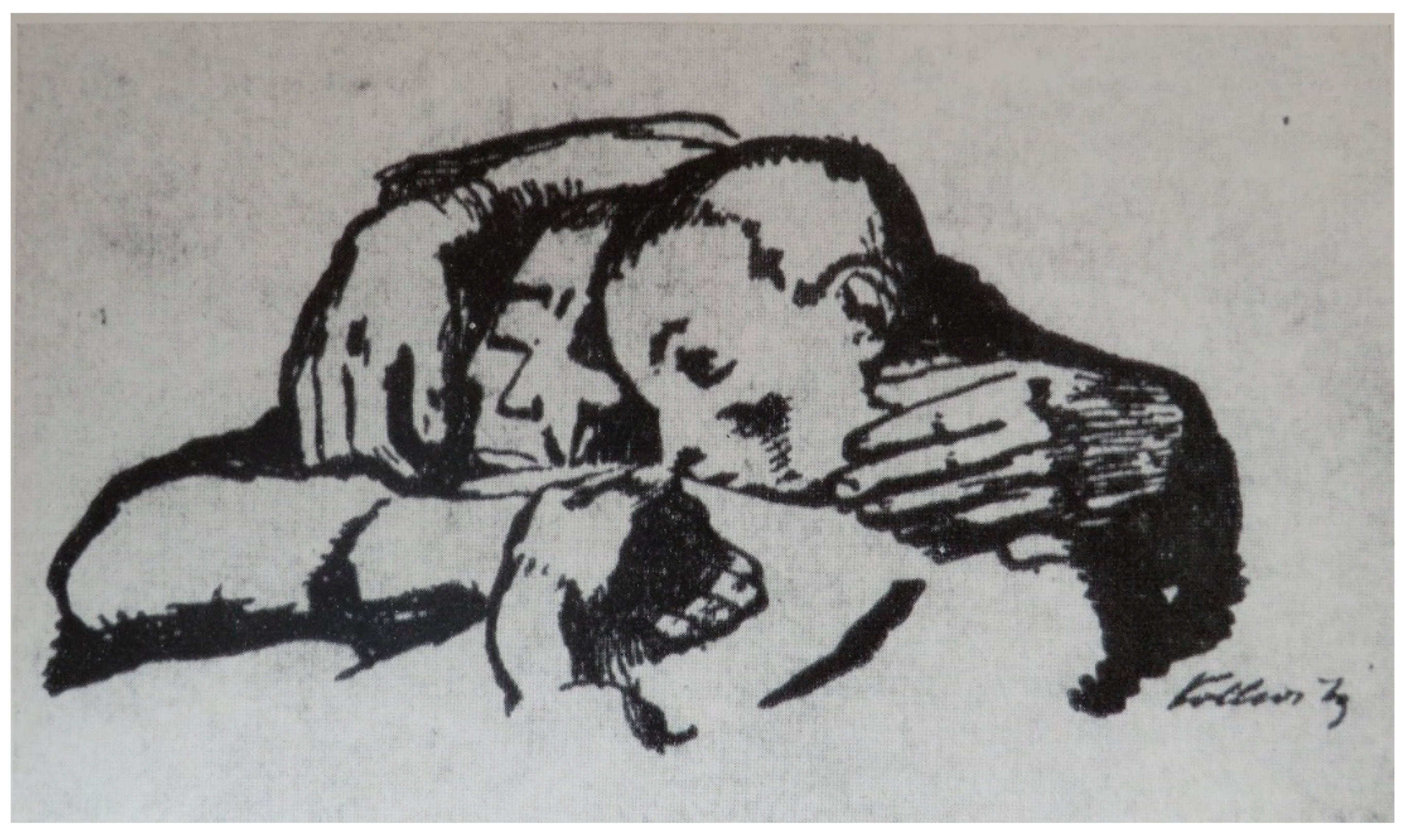
The cycle would be worked upon intermittently while Kollwitz developed ii other pieces, the cartoon Two Expressionless [Zwei Tote] (1920, Figure i), upon which she based her first e'er woodcut, and her commencement major woodcut—ironically, perhaps—a memorial to the murdered Liebknecht. The picayune known Two Expressionless was Kollwitz'south first widely disseminated antiwar moving picture. A rare epitome of soldiers in Kollwitz'south oeuvre, the cartoon was created in 1919 as the title-folio illustration to the German publication of Romain Rolland's powerful pacifist drama set during the Boer State of war, Le temps viendra (The Time Will Come, German: Die Zeit wird kommen, 1903), which would be staged by Erwin Piscator in Berlin in 1922. Kollwitz had seemingly institute in Rolland'south play, where the censor of the individual is pitted against one'due south national duty equally a soldier of state of war, the literary equivalent of her developing antiwar art.16 As Stefan Zweig described Le temps viendra, it dealt with the only authority that Rolland recognized, i.e., conscience, which was the essence of Kollwitz's protestation against Dehmel.17 Two Dead centers on an event tardily in Act Two, involving the 20-twelvemonth-old British soldier Alan and an unnamed Italian volunteer, who is a prisoner of war in Alan's regiment. During an escape attempt, the Italian and Alan mortally wound each other. As they lay dying, they condolement each other, trying to understand the forces that brought them to impale each other. Another soldier, Ebenezzer, watching them, says 'these pigs, these pigs of bankers, ministers, generals, thieves who send the poor to death and damnation for their ambition and their money'. Alan tries to accomplish out to the Italian, who moves, straightens, tilts, and embraces him. They sink into expiry. A 3rd soldier, Owen, Alan'due south friend, vows, in the final line of Act Two, that he will never kill over again.
There is no surviving written tape of why Kollwitz chose this scene above others and the artistic challenges she may have encountered in developing the final composition are restricted to her comments on the afterwards woodcut. Merely the thought that the soldiers had been fooled into fighting and dying, every bit voiced by Ebenezzer, surely resonated with Kollwitz, as it clearly echoed Kollwitz's feelings as recorded in the diary entry of 19 March 1918 (see opening quote).
While creating Two Dead, she began to develop the spare compositions that narrate War, where emotional impact was drawn from a carefully chosen motif pared down to retain simply its essential elements, keeping the viewer's eye firmly focused on the subject field. The preliminary drawings for Two Dead are insightful in this respect: a canvas of sketches in black chalk containing vi variations shows the two figures always huddled together but variously side by side or facing each other, and varying betwixt head and shoulders only or roughly half figure length studies. One of two further trial drawings, in ink heightened with white chalk, are closely representative of the final cartoon, where Kollwitz focuses on the upper body and increases the role of the hands. The hands are at present bundled to frame the figures' heads and emphasize the physical closeness—and collapse of animosity—betwixt the youthful figures as they die.18 Kollwitz had used faces and easily to deepen the emotive result in earlier works, including Adult female with Expressionless Kid (eight proofs, 1903); here, they work to concentrate the message of Rolland'south drama with groovy economic system and power.
Having resolved to employ woodcut to create the developing War series, she based her showtime ever woodcut on Ii Dead, ostensibly as practise in her newly adopted technique and in developing her own antiwar language (Effigy two). The woodcut is verified by a diary entry and a alphabetic character, confirming that it was created by 25 July 1920: 'My first woodcut is reasonably successful. Now I work with new hope on the preparatory work for the Liebknecht woodcut'.19 Relative to her subsequently woodcuts, Two Dead does non have the fullest advantage of woodcut's graphical possibilities, in that she has limited the tonal range on the right, and it seems that Kollwitz did not bother to create a reverse drawing to preserve the integrity of the original composition (only in the woodcut are the figures facing to our correct). But the nowadays woodcut is probably only a proof: 'My starting time attempt at woodcut, based on a title page drawing for Romain Rolland. It is a proof'. No later version of the woodcut is known to have been fabricated.twenty
This initial practise in woodcut helped her prepare for the much weightier responsibility in the case of the Liebknecht print, given the horrific circumstances of his death and its bear on on Berliners. Liebknecht and Rosa Luxemburg had led the Spartacist Uprising (5–12 January 1919), in the wake of the lost war. Both leaders were tortured and murdered on 15 January 1919 by the Freikorps, which Kollwitz noted in her diary on xvi Jan as the 'vile, outrageous murder of Liebknecht and Luxemburg'.21 Kollwitz agreed to his family unit's request for a deathbed portrait and was permitted to brand drawings of Liebknecht as he was laid out in the morgue and where mourners continuously filed by.22 Accompanied past her son Hans and husband Karl, and longtime friend Stan Harding-Krayl, the correspondent for The Times in Germany who also sketched Liebknecht, she made at least four of a total of at to the lowest degree six, seemingly quite true-blue sketches of the dead Liebknecht, with his 'shot-up forehead, the confront proud, the rima oris somewhat open up and painfully distorted' and the 'hands folded over one another', also as at least xx-iv direct studies of the mourners.23 Four drawings are in profile (iii of the right side of the face and one of the left) and two in roughly three-quarter to full-face up view. One of the profile drawings, executed in black, cherry, and green chalk (the others are composed of either charcoal or black chalk), and the more adult of the full-face portraits (both in charcoal) were possibly created at home rather than at the morgue, forth with further studies of the mourners.24 The final composition was developed through further drawings, where she appears to have prepared first for a print in etched or lithographic class then for a woodcut, given that the later drawings are more than tonally express and use strong, emphatic lines. After testing the impress as an etching and every bit a lithograph, she finally trialed the woodcut, arriving at the final result with the third proof.25 The arrangement of the figures borrows from before preparatory sketches for In Retentivity of Ludwig Franks (1914, Figure 3), originally destined for reproduction in the mag Kriegzeit in September 1914, but abandoned.26
Kollwitz had created a plaster model for a sculpture in 1915/16 titled Dead Soldier (Effigy 4), which may also have inspired the organisation of Liebknecht'southward body in the print.27 In repurposing these compositions for the Liebknecht work, Kollwitz gradually includes greater variation in the drawing of the mourning figures and embraces the striking linear and tonal contrast of woodcut. The resulting work is a considerable formal difference in Kollwitz's oeuvre, due non only to the tonal economy demanded past her newly adopted medium also as its intrinsic graphic nature, but also Kollwitz'due south compositional strategy, which would later come into total play in State of war. Start of all, she reduced the surrounding space visible in the 1914 piece of work to concentrate the viewer's attention exclusively on the mourners and the dead Liebknecht, thus intensifying the drama and emotiveness. Secondly, while she made conscientious studies of Liebknecht'southward confront, the finished work—in which the facial features are somewhat vague—was designed, as the words at the bottom betoken—The living to the Expressionless. In Memory of xv January 1919—every bit a portrait of his securely consequential loss for working-class Berliners. Liebknecht's body forms a powerful horizontal foreground plane, with most of the wood cut away to create a wide white swathe that works to split the viewer, positioned as mourner, and thus completing the limerick, from the mourners on the other side. The mourners, indicated chiefly through energetic, multidirectional mark-making in the faces and hand gestures, relieve but never compete with the stillness of Liebknecht'south presence. The monumentality Kollwitz achieves is enhanced past the compositional references to many well-known paintings depicting the mourning of Christ, for case Giotto's version at the Arena Chapel in Padua (1305–1306).
The print was included in a solo show for the third Workers' Art Exhibition, organized by Ernst Friedrich, that opened on 1 October 1920 on 39 Petersburger Strasse, Berlin.28 Even so, a review of the exhibition by Gertrude Alexander, who by then was a leading arts and cultural critic in the KPD, levelled heavy criticism at Kollwitz in the KPD's newspaper, Die Rote Fahne. Deriding it as nothing revolutionary, she made no mention of the Liebknecht work and instead focused on Kollwitz's images of the poor:
The deep seriousness of Käthe Kollwitz finds its focus in her devotion to a single earthly phenomenon, the Ecce Homo of the poor and the downtrodden. […] The swelling richness of human forms […], the shimmering realm of infinite beauty—all this is hateful to her. In the one gloomy theme, she finds her one and only language.
Alexander'south slight was likely due to Kollwitz'south known rejection of Liebknecht's politics. In a diary entry that ended with a note on the Rote Fahne'southward criticism, Kollwitz wrote that she had the correct, as an artist, to record the cheerio of the workers to Liebknecht—to dedicate the print to the workers—without following Liebknecht'due south politics:
I even yet say to myself, if it came to a choice between the dictatorship of Ebert and the dictatorship of (Spartacist leader and Communist Party founder Karl) Liebknecht, I certainly would vote for Ebert […] I have lived through the war and seen Peter and the g other youths dice; I am horrified and shocked by all the hate that is in the earth. I yearn for socialism, which allows men to live, and think that the world has now seen enough of murder, lies, destruction, mutilation, in short everything devilish. The communistic country that builds itself thereupon cannot be God's work.
Overall, Kollwitz's position indicates a view of Liebknecht's death equally a tragic event of war rather than any admiration of Liebknecht the revolutionary, making the print, in essence, an antiwar work.
The pictorial strategy Kollwitz initiated in Two Dead and the Liebknecht print, that synthesized form and subject in dramatic, advisedly distilled, pared-down compositions, was perfected, arduously, in War.31 The diverse drawings and impress trials for the cycle, alongside her diary entries and letters, offer fascinating insight to Kollwitz's procedure, where she variously rejected or adult ideas and tested the concluding compositions through various stages. The first woodcut trial, co-ordinate to Alexandra von dem Knesebeck's catalogue raisonné of the prints, was in early 1921, with one of the heads in the first print in the cycle, The Volunteers.32 Simply past thirty April 1922 does she finally report skilful progress: 'Plans for woodcuts which are going forth with the serial on war'. Also noting her new affiche regarding postwar food shortages in Vienna, she writes that 'the more I work, the more there dawns upon me how much work in that location is nevertheless to be done'.33 By and then, she appeared to have dispelled some insecurities— she admitted to being extremely envious of Ernst Barlach, her colleague at the Prussian Academy who, she felt, was 'so much more profound and powerful than I am'.34 Finding support in a letter (now lost) from Rolland, dated 17 October 1922,35 her intentions for the State of war cycle are made articulate in her response on 21 Oct 1922:
Your letter and greeting were for me a peachy pleasance. Throughout the war, in the four dark years, your proper name—and a few others—was a kind of comfort. Because you lot represented what 1 longed to hear. I thank you for remembering our expressionless son. It's been viii years today since he fell. He was in the field for ten days, and so his eighteen-yr life ended. He went believing and died like that. His friends had it even harder, all of whom fell in the course of these four years. Their faith faltered and became hate and disgust with the war. But the war did not release them, they almost all had to drain to death in their nigh beautiful youth. All of us—in all the warring countries—have borne the same. I have tried again and again to represent the war. I could never grasp it. Now finally I have completed a series of woodcuts which to some extent say what I wanted to say. […] These prints should travel everywhere and should summarize to everyone: that is how it was—that is what we have all borne during these unspeakably difficult years.
Writing in her diary in tardily 1922, following her attendance in a gathering at the Reichstag memorial to commemorate the war dead, she expressed delectation that she was involved with an international society opposed to war (in 1919 she became a fellow member of the main committee of the Bundes Neues Vaterland (from 1922 Deutsche Liga für Menschenrechte), one of the most important German pacifist associations), and while she felt that she did not achieve 'pure art in the sense of Schmidt-Rottluff's […], it is however art. […] I am content that my art should have purposes outside itself.37 Reporting that she is finished with the state of war cycle at the beginning of December 1922, she goes back to the impress The Parents, because 'it is far also bright and hard and clear. Hurting is very dark'. By Feb, she finally completed the cycle.38
The prints distil the mainly civilian feel of war in a remarkably succinct visual way, focusing on some of the most prominent aspects of civilian war feel. The concept for the showtime of these, The Sacrifice, appears in a diary entry describing the 1915 cartoon on the theme, Standing Mother, Pressing Baby to Face, that predates War: 'I am working on the offering. [The woman] bows far forrad and holds out her kid in deepest humility'. In the 1915 drawing, the woman clings to the child, not wanting to exist parted from information technology. But here, the adult female proffers the child, more than clearly reflecting Kollwitz'due south and other women's experiences at the outset of war—that information technology was their expectation every bit women to give up their sons to fight in the state of war.39 The Volunteers is perhaps the almost discussed of the bicycle, and equally frequently noted, references a popular theme in High german culture, the Trip the light fantastic of Death. A hand at the peak left signals the call to duty, inciting 'the dance'—the often-cited rush to join the ranks in August 1914. Kollwitz places her son's epitome closest to Death—reflecting the fact that he died in the earliest weeks of the state of war. The figures, enveloped in black, are hypnotized, helpless to resist the 'dance' which will result in what Kollwitz sees as the needless mass demise of German youth. The print conspicuously mirrors the feeling of expose felt by many, where the majestic authorities's propaganda induced many youths to 'defend' Federal republic of germany.
The Parents reflects the suffering of parents, and its pattern formed the starting point for a sculpture. It was besides the print that seemed to give her the most difficulty and was the last of the serial to exist completed. Later abandoning the version completed in December 1922, she created a tonally much darker one (as she suggested), where the figures are literally cloaked in darkness. The background, completely cut abroad, leaves only the two parents whose bodies are indicated with the lightest of cut. The hands are again used carefully to convey meaning: the slumped paw of the distraught female parent, the male parent'due south hand supporting her and the despair expressed by the hand on the male parent's head, its expressiveness emphasized by the deeply contrasting light and shade on the contours of the hand. The Widow I depicts a desolate young woman who is heavily significant and expresses, amid other things, the destitution of families who had lost fathers and husbands and were left to face the postwar economical vicissitudes lonely. This theme was repeated in numerous works by Kollwitz in the postwar years.
The composition and context of The Widow 2, the fifth in the cycle, underwent several reconfigurations, including a disturbing lithograph showing the dead mother floating in water, facing abroad from the viewer, holding her expressionless child.40 It also recalls a much earlier piece of work, Raped [Vergewaltigt], part of the Peasant State of war [Bauenkrieg] serial of etchings (1903–1908), which portrayed the suffering of peasants in sixteenth century Germanic lands. While recalling the many deaths caused by wartime destitution, it is also the only plate that suggests the aftermath of a violent act on individuals. We are presented with a woman lain on the ground and who appears to be expressionless or dying. Lying on the basis in this shadowy, nondescript space, her mouth agape, the prototype indicates that death was non peaceful; perhaps she and the kid were victims of the famine conditions in parts of postwar Germany and Austria, or they were murdered; the unnatural position of the woman's caput suggests that the neck has been wrenched. Importantly, Raped and The Widow 2 annals the inescapability of suffering during wartime. The Widow Ii showed that even if German territory was virtually untouched by the war, German civilians were non. The print borrows the potent diagonal placement of the torso on the ground and the positioning of the caput in Raped, though in The Widow II, the head is placed closest to the viewer. Nonetheless, we are denied direct engagement with the confront, which preserves the sense of abandonment and anonymity in Raped. Additionally, the presence of a pocket-sized, frightened kid hidden from the rapists in the 1908 piece of work, and as subtly placed, is repeated in The Widow 2; merely this time the child too appears dead, slumped lifelessly in its mother'south correct arm. Thus, the tragedy and viciousness in The Widow Ii appears complete. The Mothers shows a tightly packed group of mothers protecting children.41
The concluding print, The People, groups together figures representative of some social groups who felt the consequences of the state of war most profoundly. At the center is a adult female, eyes mournfully cast downward, her hand placed protectively over the child who emerges from the black of her clothing, and who is placed, symbolically mayhap, at the womb. She is somewhat ageless, representing every adult female—mother, wife, sis, grandmother—who became the victim of the war on the domicile front end. She and the kid are surrounded by v figures, all apparently male. On the left, a man clenches his fists tightly to his face, the deeply furrowed brow suggestive of angst. To the correct is a effigy with somewhat twisted features and teeth bared, surrounded past lines that suggest agitated movement. This effigy is perhaps representative of the many thousands of men who returned from the state of war with mental trauma.
In these spare compositions, Kollwitz excludes all references to place or fourth dimension, making them truly universal expressions of antiwar sentiment. The bicycle was published in three editions, the first, Edition A, being published in portfolio grade.42 While these editions allowed for limited dissemination, the works achieved further exposure through periodicals and exhibitions. An article on Kollwitz by Dora Wentscher in the pacifist periodical Die Weltbühne on 24 January 1924 described her graphic work as an 'ever-increasing force [that] indicted the civilized world for the murder of human beings and souls' and described State of war thus:
[The Widow 2] beaten to the basis by grief, lies numb on the white [ground]. Naked and far away, icy feet rising up; thrown over her breast and neck, the tired weeping kid sleeps. Just over him, in sleep still protective […] the clammy hand of the unconscious, frozen body. […] The Volunteers, with Death leading the style into the blackness. […] And and then, sublime course: the chapel of sorrow built from the bodies of father and mother, fused together from wailing for the fruit of their love, which is unripe, prematurely rotting under the earth. [In The People], the face of a female martyr, of will incarnate, adamant to give and protect the life and beauty in her womb. A humanity that contains powers like the soul of this woman, this humanity volition not perish, mangling itself. Maternal love, that is the showtime of all things, in Käthe Kollwitz stands up to telephone call and warn. 0, that all continents would hear it!
Kollwitz took part in an exhibition of antiwar art and photographs of men maimed by warfare in the newly founded International Antiwar Museum at 29 Parochialstraße, Berlin, launched to coincide with the tenth anniversary of the outbreak of World War I. Kollwitz had been acquainted with the museum'due south founder, the remarkable Ernst Friedrich, since at least 1921, when 1 of her drawings featured on the front end encompass of his Proletarischer Kindergarten. Ein Märchen- und Lesebuch für Groß und Klein [Proletarian Kindergarten—A Fairytale and Reading Volume for Young and Old], an anthology dealing with typical socialist topics such every bit country and church, enlightenment, big cities, and solidarity, including texts on war.44 When the museum was officially opened a yr later, on 1 August, 1925, Kollwitz's and Dix'south prints were included. The Berliner Tageblatt reported:
When ane enters the hall, which serves the purpose of the museum for the time being, […] the first thing that is striking is the bloodcurdling domestic war carving by Käthe Kollwitz and engravings by Dusseldorf's Otto Dix. Pictures of horror! Shaking your head, you turn away.
While Friedrich's drove of photographs and Dix's visceral imagery ensured that the German people, whose territory was near untouched, would be exposed in some way to the carnage of the Belgian and French battlefields, Kollwitz's prints were a reminder of the widespread suffering of ordinary people on the home front. From 1925, Kollwitz's work likewise illustrated some issues of Friedrich's newspapers Dice Schwarze Fahne and Neue Jugend (Figure v). Friedrich put on view numerous photographs of the physically maimed, including many of the Gueules cassées—the men whose faces were disfigured—alongside some of Otto Dix's suite of fifty etchings entitled The War and Kollwitz'southward seven woodcuts.
By this fourth dimension, Kollwitz had completed numerous posters, including one deputed by the German language Communist Party (KPD) for an result that had been burning since 1871—Paragraph 218 of the Abortion Bill and titled Nieder mit den Abtreibungsparagraphen! [Down with the Abortion Paragraph!] and the other for the Internationale Gewerkschaftsbund (IGB, International Federation of Trade Unions—IFTU) titled The Survivors [Die Überlebenden] (Figure vi).46 Every bit Jutta Bohnke-Kollwitz noted, this and other antiwar posters were very important to the artist, and she worked hard to make them effective, for both their connection to the retentivity of her dead son and in her commitment to the antiwar campaigns.47 Regarding The Survivors, Kollwitz wrote to her friend Beate Bonus-Jeep that 'the Federation of Trade Unions senses all new frightening possibilities of war and wants to make counter propaganda. Large posters, which logically think the consequences of the war, are published in 14 European countries. The first poster was made by Steinlen, the 2nd I should make. You can imagine how completely I am going to do that'.48 The commencement printing alone amounted to a g copies, with, below the image, the inscriptions 'The Survivors' to the left and 'No more War' to the right in German, Swedish, Danish, and Dutch. In the poster, a gaunt female parent holds to her three of the immature children in the foreground, while amid the figures in the background are two blinded war veterans.49
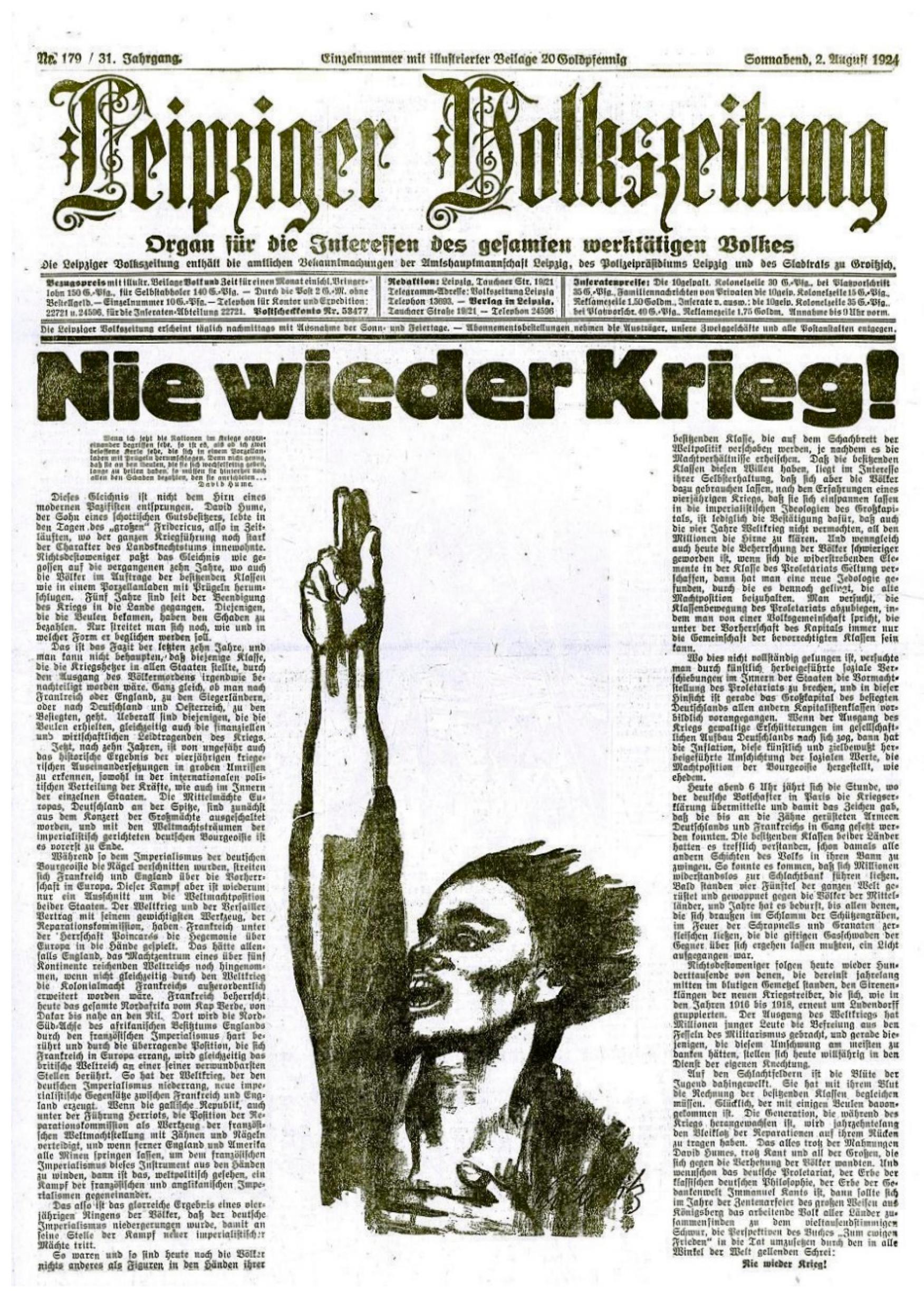
Simply it was another poster, Nie wieder Krieg! [No More State of war!] that became (and remains to this 24-hour interval) one of the near potent symbols of the international peace movement. Ane of its first public appearances was as a large forepart-folio illustration in a special antiwar edition of the paper, the Leipziger Volkszeitung, published on Saturday, 2 Baronial 1924, the day before the Nie wieder Krieg! [No more than War!] rally on the Augustusplatz in Leipzig, organized every bit office of the Central German Youth Day of Socialist Youth Workers [Der Mitteldeutsche Jugendtag der Sozialistischen Arbeiterjugend] (Figure 7). It is arguably her well-nigh perfectly distilled, politically charged visual argument. The iii drawings and the single version of the lithographic print point that she had decided on its blueprint quite quickly. The effigy is androgynous in advent, and this vagueness seems deliberate: as neither expressly male nor female person, the figure becomes universally representative of antimilitarism, while the figure's youthfulness was fully in keeping with an event that sought to heighten antiwar awareness in a generation that was too young to get to war in 1914 and which evidently included many who lamented the fact.50
The figure'southward raised hand is the Schwurhand [oath hand], intended to corroborate the words spoken when taking an oath. The centuries-old Schwurhand had long been in utilise in Germany, for swearing an adjuration in courtroom or swearing in politicians elected to government posts, for instance. Kollwitz may have likewise taken her inspiration from youth worker Max Westphal during the first Reich Youth Solar day of the Socialist Youth Workers (1920), when he stretched out his ane arm (he lost the other in the war) as a Schwurhand, and exclaimed 'never again war'.51 Typically, as in Kollwitz's poster, the right mitt is raised, the palm of the hand facing the viewer, the thumb, alphabetize, and center fingers (the Schwurfinger) stretched parallel to each other and the ring and little fingers bent. In its religious (Christian) connotations, the adjuration hand symbolizes the subjugation of the people under the Trinity of God the Father, Jesus, and the Holy Spirit. Every bit such, the gesture indicates a hope never to go to war again. Illustrations of work by Kollwitz'south contemporaries, Leipzig-born George Kretzschmar, who had served in the war, and the pacifist Flemish artist Frans Masereel, who, because he had refused to fight, was forced to live outside Belgium for several years, were shown on internal pages as well equally the satirical work, Peace, an Idyll, by nineteenth century French artist and satirist Honoré Daumier (1808–1879.52 Among the literary contributors was a young Walter Mehring, one of the most prominent satirical writers of the Weimar Commonwealth, with his essay Der Aufbruch zur Front [The Departure for the Forepart], reproduced on page two of the accompanying feuilleton.53
The content of the special edition of the Leipziger Volkszeitung was drawn from the lengthier book Nie wieder Krieg!, published by the Due west Saxony branch of the Sozialistischen Arbeiter-Jugend and which included several reproductions of Kollwitz's War cycle: The Sacrifice, The Volunteers, The Widow Two and The Mothers.54 As in the Leipziger Volkszeitung, the offset image encountered by the reader was the androgynous figure in Kollwitz'southward affiche, this time on the volume jacket. Reviewing Nie wieder Krieg!, the young Dora Heinemann emphasized the importance of Kollwitz's and other creatives' voices in the antiwar entrada:
Under this title the Socialist Workers' Youth, West Saxony Commune, publishes an excellent small publication. It is and then of import and so valuable to usa pacifists because it expresses the determination, the unconditionality and the will to human action of those who are most important, the masses of youths who would exist the army in the side by side war. […] This colourful muddle of visual arts, poetry, politics and science, which stand side by side here, becomes the most wonderful coexistence of diverse forms of expression for equal paths, for equal will. In addition to pictures by Käthe Kollwitz, Dix, George Groß, Masereel, there are words past Toller, Eisner, Engelke. The eternally young, Karl Liebknecht and Rosa Luxemburg, again take their say in this book of youth. […] This manifesto should be bachelor to all those who want to larn from a truly young, antimilitarist fighting spirit.
Thus Kollwitz's antimilitarist art was again enmeshed with the leading antiwar voices of the 24-hour interval, including that of famous left-wing expressionist poet and playwright, Ernst Toller, whose contribution was his antiwar poem, Marschlied [Marching Song] (1915). A bilingual French and German edition of Nie wieder Krieg! was published in 1925, preserving Kollwitz'due south poster figure as the embrace image as well as the woodcuts from Krieg. Also included was a report by Toller on the ii August, 1924 antiwar rally in Leipzig, illustrated by Kollwitz's Sacrifice.56
In Nie wieder Krieg, Kollwitz's woodcut The Mothers appeared aslope a poem of the aforementioned proper noun by Toller. Toller had served in the war and suffered psychological collapse as a result, and afterward spent years campaigning against militancy. In this poem, he describes how unlike arcadian portrayals of battlefield burials, the bodies of the mothers' dead sons lay decomposing on the rippled land or trapped in barbed wire, or how they returned habitation crippled or blind. Another woodcut from War, The Volunteers, accompanied an essay by prominent antiwar apostle Helene Stöcker, with whom Kollwitz was acquainted since at least 1920. Entitled Militarism, War and Sexuality, it discussed war as an inevitable consequence of militarized culture. Stöcker had founded Paco (the Esperanto give-and-take for 'Peace') in Bilthoven, Holland in 1921, which was later known every bit the War Resisters' International and is nevertheless active today.
These activities reveal how deeply embedded Kollwitz was in the No More War campaign, both in Germany and internationally, besides equally the pragmatism and earnestness she committed to the creation of the works. While her piece of work was not lonely in contesting the abstract concepts of honour and glory fastened to the popular memorialization of the state of war in Weimar Germany, where she and other artists and writers refused to heroize individuals or whatsoever attribute of war, her elimination of references to a specific fourth dimension or place made her piece of work universally legible indictments of the real sacrifices demanded by World War I in every nation. Within the considerable body of antiwar art produced in German language during the Weimar era and beyond, her War bicycle remains a singular, universal antiwar statement of the home front experience of war.57
Kollwitz's activism, through her fine art, continued into the Nazi era. As her son Hans recalled, 'when Nazism came knocking at the gates, she publicly took sides against information technology and accepted the consequences'.58 And the consequences were considerable. Past the belatedly 1930s, they had completely banned her from exhibiting, fabricated at to the lowest degree xl of her works disappear, and had her fired from her professorship at the Prussian Academy in Berlin. She had left her home on Weissenburger Strasse in Berlin before it was destroyed on 23 November 1943. Because she died on 22 April 1945, during the last days of World State of war Two, her work would never be exhibited again during her lifetime. To the end, she held to her belief, No More War, and repeatedly urged that 'idealism and readiness for cede of the immature people should be turned non toward state of war, but toward building a better life and society.59
Funding
This inquiry received no external funding. The work of Käthe Kollwitz is in the public domain. The writer declares that photographic rights, where the photographer or institution is known, have been granted.
Conflicts of Involvement
The author declares no disharmonize of involvement.
References
- Alexander, Gertrude. 1920. Arbeiter-Kunst-Ausstellung. Die Rote Fahne, October 12, v. [Google Scholar]
- Bader, Herbert. 1979. Nie wieder Krieg. Der Kampf für Frieden und Abrüstung seit 1900. Eine Dokumentation. Berlin: Elefanten Printing. [Google Scholar]
- Bessel, Richard. 1993. Deutschland after the First Globe War. London: Clarendon Press. [Google Scholar]
- Bittner, Herbert. 1959. Kaethe Kollwitz. Drawings. London and New York: Thomas Yoseloff. [Google Scholar]
- Bohnke-Kollwitz, Jutta, ed. 1992. Käthe Kollwitz, Briefe an Den Sohn: 1904 Bis 1945. Berlin: Siedler. [Google Scholar]
- Bohnke-Kollwitz, Jutta, ed. 2012. Käthe Kollwitz. Die Tagebücher 1908–1943, New edition. Munich: btb. [Google Scholar]
- Bonus Jeep, Beate. 1948. Sechzig Jahre Freundschaft mit Käthe Kollwitz. Boppard: Rauch. [Google Scholar]
- Dehmel, Richard. 1918. Einzige Rettung. Vorwärts, Oct 22, 7. [Google Scholar]
- Friedrich, Ernst, ed. 1921. Proletarischer Kindergarten Ein Märchen- und Lesebuch für Groß und Klein. Berlin: Buchverlag der Arbeiter-Kunst-Ausstellung. [Google Scholar]
- Heckmann, Stefanie, and Hans Ottomeyer. 2009. Kassandra. Visionen des Unheils 1914–1945. Dresden: Sandstein. [Google Scholar]
- Heinemann, Dora. 1924. Review. Nie Wieder Krieg. Berliner Wissenschafts-Verlag 24: 246–47. [Google Scholar]
- Hille, Karoline. 2017. Paragraph 218 and the "Women's Affair". In Splendour and Misery in the Weimar Republic. Edited past Ingrid Pfeiffer. Munich: Hirmer, pp. 183–95. [Google Scholar]
- Hoffmann, Tobias, ed. 2018. Berliner Realismus. Von Käthe Kollwitz bis Otto Dix. Sozialkritik—Satire—Revolution. Cologne: Wienand Verlag. [Google Scholar]
- Käthe Kollwitz-Museum, Berlin, ed. 2017. Käthe Kollwitz und ihre Freunde. Berlin: Lukas Verlag. [Google Scholar]
- Kollwitz, Käthe. 1918. An Richard Dehmel! Entgegnung von Käthe Kollwitz. Vorwärts, October 28, 3. [Google Scholar]
- Kollwitz, Hans, ed. 1981. "Ich will wirken in dieser Zeit": Auswahl aus den Tagebüchern und Briefen, aus Graphik, Zeichnungen und Plastik, 5th ed. Berlin: Mann. [Google Scholar]
- Kollwitz, Hans, ed. 1985. Ich sah die Welt mit liebevollen Blicken: Ein Leben in Selbstzeugnissen, eighth ed. Wiesbaden: Fourier. [Google Scholar]
- Kollwitz, Hans, ed. 1988. The Diary and Letters of Kaethe Kollwitz. Clara Winston, and Richard Winston, transs. Evanston: Northwestern University Printing. [Google Scholar]
- Kühn, Fritz, ed. 1924. Nie Wieder Krieg! Leipzig: Sozialistische Arbeiter-Jugend, Bezirk Westward-Sachsen. [Google Scholar]
- Kühn, Fritz, ed. 1925. Nie Wieder Krieg. Leipzig: Roter Türmer Verlag. [Google Scholar]
- McCausland, Elizabeth. 1937. Käthe Kollwitz. Parnassus 9: 20–25. [Google Scholar] [CrossRef]
- Mosse, George L. 1991. Fallen Soldiers: Reshaping the Memory of the World Wars. Oxford: Oxford University Press. [Google Scholar]
- Nagel, Otto, ed. 1972. Käthe Kollwitz. Die Handzeichnungen (Catalogue Raisonné). Berlin: Henschelverlag Kunst und Gesellschaft. [Google Scholar]
- Prelinger, Elizabeth. 1992. Käthe Kollwitz. Washington, DC: National Gallery of Art. [Google Scholar]
- Rolland, Romain. 1921. Die Zeit wird kommen. Drama in Drei Akten. Leipzig: EP Tal & Co. Verlag. [Google Scholar]
- Sharp, Ingrid. 2011. Käthe Kollwitz's Witness to War: Gender, Authority, and Reception. Women in German Yearbook 27: 87–107. [Google Scholar] [CrossRef]
- Siebrecht, Claudia. 2013. The Aesthetics of Loss: German language Women's Art of the First Earth War. Oxford: Oxford University Press. [Google Scholar]
- Spree, Tommy. 2017. Ich kenne keine Feinde. In Krieg dem Kriege. Edited by Anti-Kriegs-Museum. Berlin: Anti-Kriegs Museum. [Google Scholar]
- von dem Knesebeck, Alexandra, ed. 2002. Käthe Kollwitz. Werkverzeichnis der Graphik. Bern: Verlag Kornfeld. [Google Scholar]
- Wentscher, Dora. 1924. Käthe Kollwitz. Dice Weltbühne twenty: 110–12. [Google Scholar]
- Whitner, Claire, ed. 2016. Käthe Kollwitz and the Women of War. Femininity, Identity and Art in Frg during World Wars I and II. New Haven: Yale University Printing. [Google Scholar]
- Ziemann, Benjamin. 2013. Contested Commemorations: Republican War Veterans and Weimar Political Culture. Cambridge: Cambridge University Printing. [Google Scholar]
- Zweig, Stefan. 1921. Romain Rolland. The Man and His Piece of work. Translated by Eden Paul, and Cedar Paul. New York: Thomas Seltzer. [Google Scholar]
| one | Kollwitz (1988, p. 87), original High german in (Bohnke-Kollwitz 2012, p. 359). In Bohnke-Kollwitz, the text is dated 20 March 1918. Hans Kollwitz's English language edition of his mother'southward diary and letters, originally published in 1955, includes simply a very limited number of diary entries and letters. Hans's much more than all-encompassing German compilations include (Kollwitz 1981, 1985). Bohnke-Kollwitz's edition of her grandmother's diaries (Jutta was Hans'due south daughter) is comprehensive (accompanied past detailed notes), though it is possible that not all entries are included. Where an entry too appears in the English edition of the diaries and letters, the references for both the English and the German edition will be given. In all other German sources, the translations are my own. |
| 2 | The German Nie wieder Krieg [No More than War] movement (not to be confused with the British No More War Movement (NMWM), founded 1921) existed from the beginning of World War I, growing to much greater numbers by 1920, the kickoff year that the major annual demonstrations were held in various German language cities on the anniversary of the outbreak of World War I (ane August 1914), and which would continue in force until 1925, when numbers had already begun to wane. By 1921, more than twenty antiwar organisations had been formed in Frg as function of the Nie wieder Krieg move. See for instance (Bader 1979). For insight into postwar German politics and lodge in relation to war commemoration, come across for example (Ziemann 2013). |
| 3 | A rich body of antiwar art was produced in Germany betwixt 1914 and 1945, and many of the artists remain little studied. See (Heckmann and Ottomeyer 2009). |
| 4 | (Whitner 2016; Prelinger 1992, pp. 13–14). Kollwitz was included in (Siebrecht 2013). German-but publications include (Hoffmann 2018; Käthe Kollwitz-Museum Berlin 2017). |
| 5 | (Sharp 2011, p. 87); (McCausland 1937, p. 23). |
| 6 | Kollwitz (1988, p. 72). Original High german (Bohnke-Kollwitz 2012, p. 269). |
| 7 | Kollwitz (1988, p. 65). Original German in (Bohnke-Kollwitz 2012, pp. 165–66). |
| 8 | Diary entry, Monday, 10 August 1914, in (Bohnke-Kollwitz 2012, p. 152). |
| 9 | Dehmel (1918, p. 7). Translated article title: Sole Salvation. |
| ten | Kollwitz (1918, p. 3). Translated article championship: To Richard Dehmel! A Response from Käthe Kollwitz. The commodity is translated into English in Han's Kollwitz's edition. Run across (Kollwitz 1988, pp. 88–89). The 'greater poet' Kollwitz refers to is Goethe. |
| 11 | Popular publications such as those by the Reicharchiv [Reich Archive] fulfilled an important role in publishing the accounts of ordinary soldiers' war experiences, but there was little to debunk what cultural historian George Mosse called the Myth of the State of war Experience, which glorified military experience equally a 'man-making' exercise while playing downward the savagery of modern warfare and its concrete and psychological bear upon on soldiers. Meet (Mosse 1991). Militant organizations such as the Freikorps and the Stahlhelm were formed barely a month after the Armistice and played a key role in converting the myth into a militarized, political mass motion. For a detailed business relationship of postwar Deutschland and militarism, see, for example, Richard Bessel' (1993) landmark study. |
| 12 | 'I am aback that I still do not have sides and almost suspect that if I declare that I vest to no party, the real reason for this is cowardice. Actually, I am not revolutionary at all, but evolutionary, because I am praised equally an artist of the proletariat and the revolution and I am increasingly pushed into the part'. Diary entry, October 1920 (no verbal appointment given). See (Bohnke-Kollwitz 2012, p. 483). |
| 13 | Diary entry, 8 December 1918 (ibid., p. 388). |
| fourteen | Kollwitz reveals in this letter that she was besides hesitant to make known her experiences and feelings on the war, also as the discrepancy she felt between the themes of life and decease and the 'stuperous nature of studio work'. Come across (Bohnke-Kollwitz 1992, p. 163). |
| 15 | Diary, 25 June 1920. See (Kollwitz 1988; Bohnke-Kollwitz 2012, p. 477). The italics are used only in Bohnke-Kollwitz. |
| 16 | Kollwitz's drawing illustrated the title page of the fourth and fifth printings of the German language version, (Rolland 1921) and the version of the drawing used for the title page is lost (Nagel 1972, p. 354). Each re-create is numbered upwards to a total of yard copies. The play was written in 1903 and explored numerous antiwar themes through an episode in the Boer War (1899–1902). Rolland described Kollwitz in 1927 thus: 'The piece of work of Kaethe Kollwitz, which reflects the ordeal and hurting of the humble and simple, is the grandest German poem of this age. This woman of virile heart has looked on them, has taken them into her motherly arms, with a solemn and tender compassion. She is the voice of the silence of the sacrificed'. See for example (Bittner 1959, p. 8). |
| 17 | (Zweig 1921, p. 119). |
| 18 | Nagel (1972, p. 355) records three separate sheets with drawings for Zwei Tote. The less developed of the ii further drawings (in pencil) is held by the Kollwitz Museum, Cologne (NT (830a)). |
| 19 | (Bohnke-Kollwitz 2012, p. 480). |
| xx | Kollwitz, letter to Max Lehrs, 1 Feb 1921 (Archive of the Staatliche Kunstsammlungen Dresden), quoted in (Nagel 1972, p. 472). Lehrs was the Director of the Kupferstich-Kabinett (Prints and Drawings Cabinet) at the SKD, the first museum to promote Kollwitz, and Lehrs is widely credited with establishing Kollwitz every bit an artist. |
| 21 | (Bohnke-Kollwitz 2012, p. 400). |
| 22 | Come across timeline of the artist'south life on the website of the Käthe Kollwitz Museum, Cologne: https://www.kollwitz.de/zeitstrahl. |
| 23 | Diary, 25 Jan 1919 (Bohnke-Kollwitz 2012, p. 402). |
| 24 | Run across (Nagel 1972, pp. 340–52). |
| 25 | Käthe Kollwitz, Memorial Sheet for Karl Liebknecht, 1920. Woodcut, 34.ix cm × 49.9 cm; sheet: 47.7 cm × 63.7 cm. The final print, together with other versions and a number of preparatory drawings can be viewed on the website of the Käthe Kollwitz Museum, Cologne: https://world wide web.kollwitz.de/gedenkblatt-fuer-karl-liebknecht. |
| 26 | See the information on the webpage for the drawing on the website of the Käthe Kollwitz Museum Cologne: https://www.kollwitz.de/dem-andenken-ludwig-franks. |
| 27 | This sculpture (German: Liegender toter Soldat or Toter Soldat), now known only through the photo, formed part of an abandoned design for a 3-figure memorial (male parent, mother, son). Kollwitz later created the two-figure piece of work Grieving Parents (1932), now at Vladslo German war cemetery, Belgium, where Peter is buried. 'I have begun a work for Peter, to accolade him and to honour all the young fallen volunteers. […] A sacorphagus or rather a smoothen, simple long base on which the immature dead man lies'. Letter to Beate Bonus-Jeep, (undated/1915), (Bonus Jeep 1948, p. 188). |
| 28 | (Käthe Kollwitz-Museum Berlin 2017, p. 95). |
| 29 | (Alexander 1920, p. 5). Kollwitz noted the criticism in her diary in Oct 1920 (no exact date given). Encounter (Bohnke-Kollwitz 2012, p. 483). |
| 30 | Diary entry, October 1920 (no verbal date given), (Bohnke-Kollwitz 2012, p. 483). |
| 31 | Käthe Kollwitz, War, 1918–22/23. Cyle of 7 woodcuts, slightly variable proportions, average size 47.5 cm × 65.four cm. The entire cycle of War, together with various preparatory prints and drawings, can exist viewed on the website of the Käthe Kollwitz Museum, Cologne: https://world wide web.kollwitz.de/folge-krieg-uebersicht. |
| 32 | (von dem Knesebeck 2002, p. 496). |
| 33 | (Kollwitz 1988, p. 530; Bohnke-Kollwitz 2012). |
| 34 | Kollwitz had been elected to the Prussian University in 1919, the first woman then elected in over a hundred years. Kollwitz had just seen Barlach's play, Dice echten Sedemunds (1921). Barlach created numerous antiwar prints and sculptures in the postwar period. |
| 35 | Bohnke-Kollwitz (2012, p. 540). 'I have received a good alphabetic character from Romain Rolland' [Ich habe einen guten Brief von Romain Rolland bekommen]. |
| 36 | Ibid., pp. 877–78. |
| 37 | Kollwitz (1988, p. 104). See (Bohnke-Kollwitz 2012, p. 542). The English translation gives no specific date (Nov 1922). Bohnke-Kollwitz dates the entry every bit 4 December 1922. |
| 38 | (Bohnke-Kollwitz 2012, pp. 542–43, 548). |
| 39 | Kollwitz (1988, p. 64). Come across (Bohnke-Kollwitz 2012, pp. 184–85). Standing Mother, Pressing Baby to Confront, 1915, charcoal on gray newspaper fixed with shellac, Käthe Kollwitz Museum, Cologne. |
| 40 | The Widow II (discarded first version), before May 1920. Lithograph, 38 cm × 62 cm. Dr. Richard A. Simms Drove, Getty Research Institute, Los Angeles. Nagel (1972, pp. 386–87) records two related drawings. Knesebeck records one lithographic trial for the showtime version (von dem Knesebeck 2002, pp. 462–63), one lithograph and 2 woodcut states for the second version (ibid., pp. 464–65, 528–29) and 7 states of the terminal woodcut limerick (ibid., pp. 530–33). |
| 41 | This print's composition reappears in sculpted form in Tower of Mothers (1937/38). Kollwitz had noted the thought of creating a sculpted version of the print on xxx Apr 1922, describing it equally a circle of standing mothers protecting their children, sculpted in the round. See (ibid., pp. 530–31). |
| 42 | (von dem Knesebeck 2002, pp. 173–76, 178–79, 190). Edition A of 100 was printed on majestic Nihon newspaper; Edition B of 100 was printed on wove paper, and Edition C of 200 was printed more than cheaply from an electrotype plate on simulated Nippon paper. Edition A: Käthe Kollwitz, Krieg, 1923. Portfolio of vii woodcuts and one woodcut cover (Die Witwe I), each canvas approx. 47.6 cm × 65.ix cm. Emil Richter, Dresden. |
| 43 | (Wentscher 1924, pp. 110, 112). |
| 44 | (Friedrich 1921). The volume featured work by Otto Nagel and others in improver to Kollwitz. |
| 45 | (Spree 2017, p. 56). |
| 46 | Kollwitz, Nieder mit den Abtreibungs-Paragraphen [Down with the Abortion Paragraph], 1923. The prohibition was entered into the Criminal Code of the High german Empire in 1871, and meant that a woman who underwent an ballgame besides equally whoever performed the abortion would receive a prison sentence. Run across for instance (Hille 2017, pp. 183–95). The new independence of women, brought nearly by the new dependence on women as a result of the war effort, and particularly because women had been granted suffrage on 30 Nov, 1918, brought the outcome of the Ballgame Paragraph to a head considering it was a revenue enhancement on women'south autonomy. |
| 47 | Bohnke-Kollwitz (2012, p. 880) also notes that they were besides of import for financial reasons: 'With some relief, she writes to her son Hans on 21 September: "Today comes [Edo] Fimmen and brings me 200 Dutch guilds for the antiwar affiche"'. Fimmen was Secretary Full general of the IFTU. |
| 48 | Kollwitz, quoted in (von dem Knesebeck 2002, p. 585). |
| 49 | Another version of the poster was printed for the High german antiwar day on 21 September 1924, with the same text equally before and with additional text beneath: Antikriegstag am 21 September 1924. The Internationale Gewerkschaftsbund are credited in smaller text at the bottom left. Run into von dem Knesebeck (2002, pp. 582–85) for this and further details regarding the various international versions of the poster. |
| 50 | The previously mentioned Freikorps included many immature men who were too young to fight in 1914. Kollwitz did not ascertain the figure in Nie wieder Krieg! as either male or female in her written accounts. |
| 51 | For the reference to Westphal, meet the website of the Käthe Kollwitz Museum, Cologne: https://www.kollwitz.de/plakat-nie-wieder-krieg. |
| 52 | The reproductions of Kretzschmar's works were Das Gespenst des Krieges [The Spectre of War] and Der Schutzengraben [The Trench]. Masereel's were Das ist kein Traum [This is not a Dream] and Die Toten reden [The Dead are Talking]. |
| 53 | Mehring also contributed to Die Weltbühne, edited by Kurt Tucholsky up to 1927 and then past Carl von Ossietsky. |
| 54 | (Kühn 1924). |
| 55 | (Heinemann 1924). The precocious journalist and writer Heinemann was committed to social justice from an early age, and became a fervent anti-Nazi activist. She was found dead in London, nether mysterious circumstances, on 4 April 1935. |
| 56 | (Kühn 1925, pp. 66–68). |
| 57 | Run across the aforementioned (Heckmann and Ottomeyer 2009) for insight to German antiwar fine art during the Weimar Republic. The book includes piece of work past seventy-7 artists. |
| 58 | Ibid., p. 8. |
| 59 | Ibid. |
Figure 1. Käthe Kollwitz, Two Dead [Zwei Tote], 1920. Pen and ink, dimensions unknown. According to (Nagel 1972), the original drawing is lost. Paradigm source: (Nagel 1972, p. 355).
Figure 1. Käthe Kollwitz, Two Expressionless [Zwei Tote], 1920. Pen and ink, dimensions unknown. According to (Nagel 1972), the original drawing is lost. Image source: (Nagel 1972, p. 355).
Effigy 2. Käthe Kollwitz, Two Expressionless [Zwei Tote], 1920. Woodcut, 19.1 cm × 27.five cm. Kn 158 IV, Kölner Kollwitz-Sammlung © Käthe Kollwitz Museum Köln.
Figure two. Käthe Kollwitz, 2 Dead [Zwei Tote], 1920. Woodcut, 19.1 cm × 27.5 cm. Kn 158 IV, Kölner Kollwitz-Sammlung © Käthe Kollwitz Museum Köln.
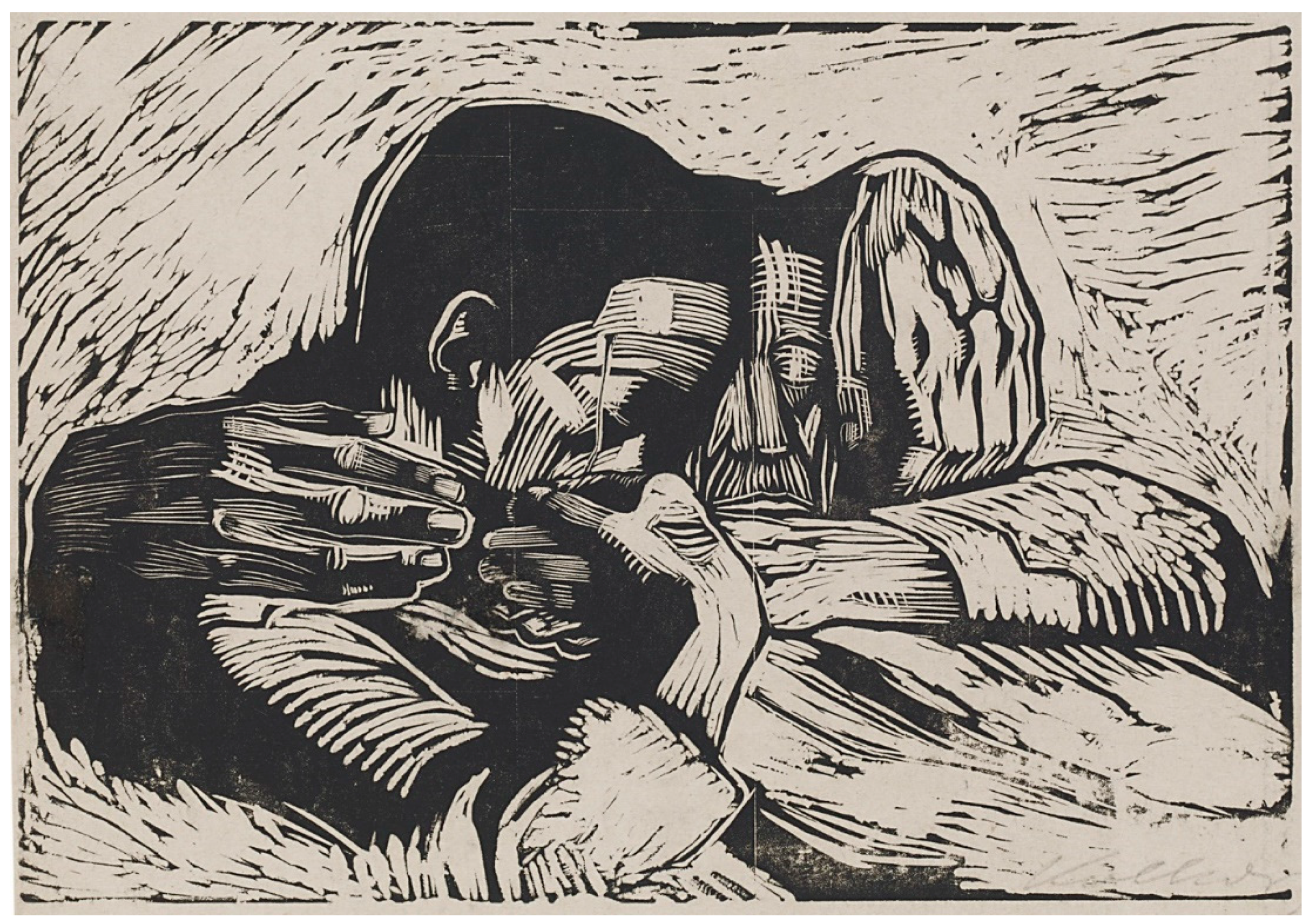
Figure 3. Käthe Kollwitz, In Memory of Ludwig Franks [Dem Andenken Ludwig Franks], rejected 2d version, 1914. Chalk lithograph (from an unknown drawing on laid paper), 33.seven cm × 30.6 cm. Kn 131, Kölner Kollwitz-Sammlung © Käthe Kollwitz Museum Köln.
Figure iii. Käthe Kollwitz, In Retentivity of Ludwig Franks [Dem Andenken Ludwig Franks], rejected second version, 1914. Chalk lithograph (from an unknown drawing on laid paper), 33.7 cm × xxx.6 cm. Kn 131, Kölner Kollwitz-Sammlung © Käthe Kollwitz Museum Köln.
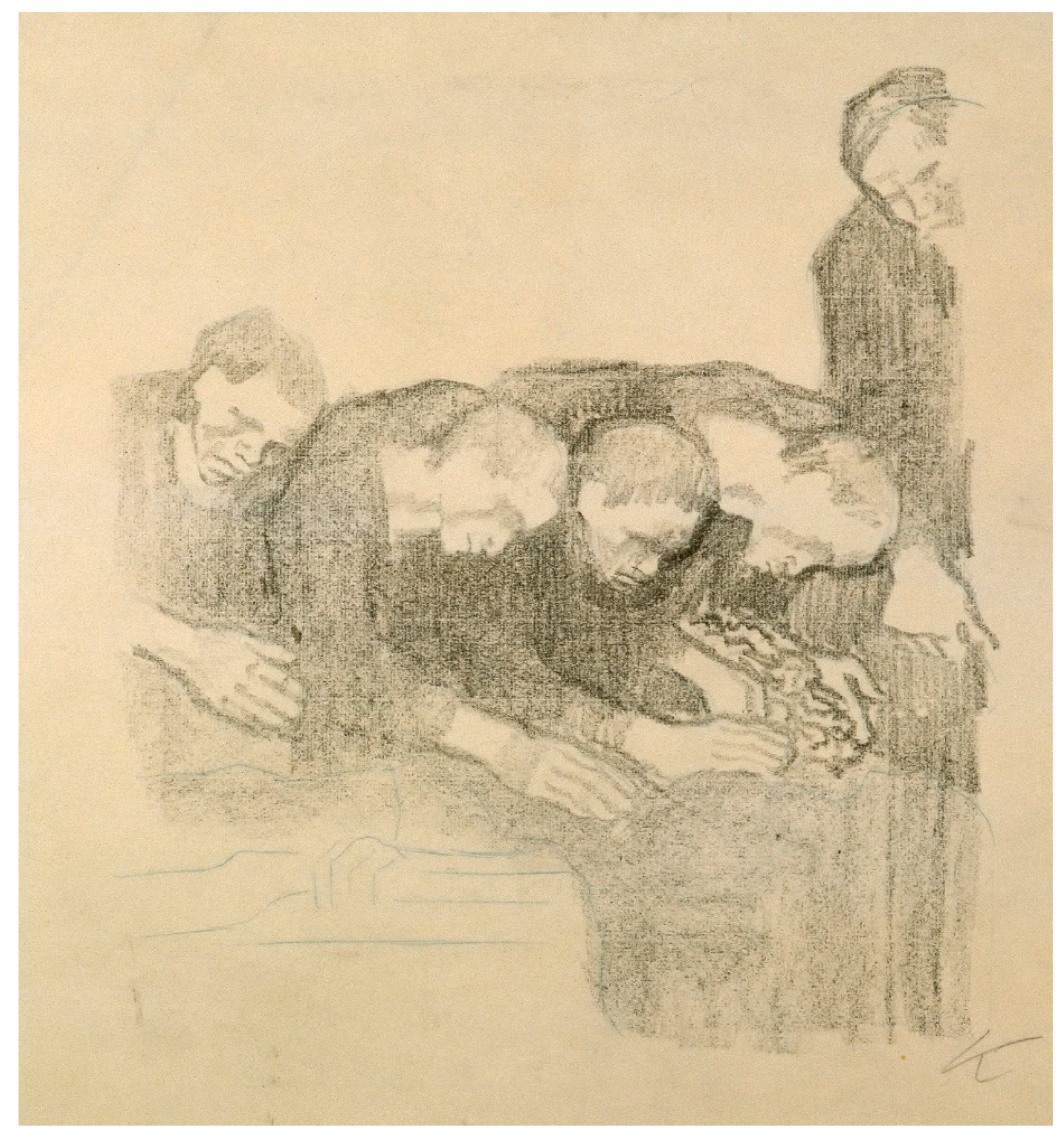
Figure four. Käthe Kollwitz, Reclining Dead Soldier (Peter Kollwitz), 1915/16. Plaster, dimensions unknown, (presumed lifesize), lost. Model for a three-figure memorial (not completed). Photograph, Landesarchiv, Berlin. Photographer unknown.
Figure 4. Käthe Kollwitz, Reclining Dead Soldier (Peter Kollwitz), 1915/16. Plaster, dimensions unknown, (presumed lifesize), lost. Model for a three-figure memorial (not completed). Photograph, Landesarchiv, Berlin. Photographer unknown.

Figure 5. Front end page of Freie Jugend, Week 3, Volume eight (c. 21 January 1926), illustrated by Kollwitz's Memorial to Karl Liebknecht (1920).
Effigy 5. Front folio of Freie Jugend, Week three, Volume 8 (c. 21 Jan 1926), illustrated by Kollwitz's Memorial to Karl Liebknecht (1920).
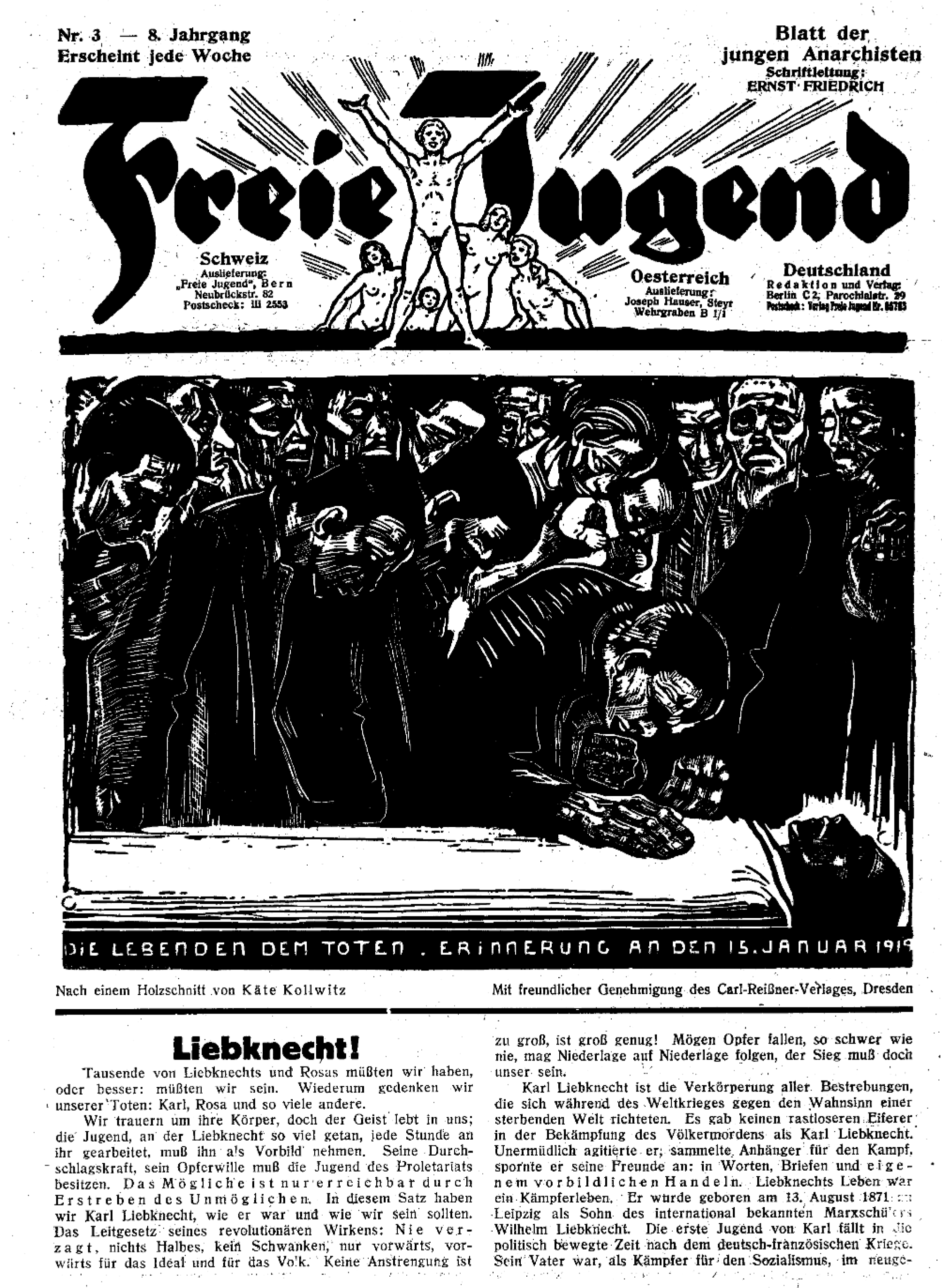
Figure 6. Käthe Kollwitz, The Survivors, 1923. German version of the poster. Based on the lithograph of the same name on biscuit wove paper, 1923. 56.2 cm × 68.5 cm. See (von dem Knesebeck 2002, pp. 582–85).
Effigy 6. Käthe Kollwitz, The Survivors, 1923. High german version of the poster. Based on the lithograph of the aforementioned proper noun on beige wove paper, 1923. 56.ii cm × 68.v cm. See (von dem Knesebeck 2002, pp. 582–85).

Figure 7. Forepart page of the Leipziger Volkszeitung, Sabbatum, two August 1924, with an analogy of Kollwitz'southward No More State of war poster figure.
Figure 7. Front end folio of the Leipziger Volkszeitung, Sat, 2 August 1924, with an illustration of Kollwitz'due south No More than War affiche figure.
© 2020 past the writer. Licensee MDPI, Basel, Switzerland. This article is an open access article distributed nether the terms and weather of the Creative Eatables Attribution (CC By) license (http://creativecommons.org/licenses/by/four.0/).
gallaherexprion1962.blogspot.com
Source: https://www.mdpi.com/2076-0752/9/1/36/htm
Belum ada Komentar untuk "What Does Kathe Kollwitz Art the Mothers Show Never Again War by Kathe Kollwitz"
Posting Komentar